|
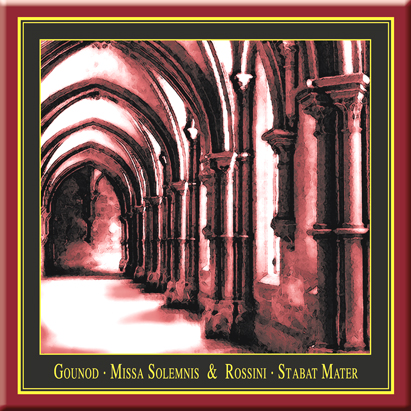
A life-recording of the concert, which took place at the convent church in Maulbronn, june 12./13. in 1999, produced by A.O.Grimminger & J.S.Kindler.
"Messe solennelle de Saint-Cécile"
by Charles Gounod (1818-1893)
Charles Gounod has become famous for his opera "Margarete" above all. It is hardly known that his first passion was clerical music. The "Messe solennelle de Saint-Cécile" is worth to be called the most beautiful among his numerous clerical compositions. The work is distinguished by a maze of marvellous melodies, an extremly lined-up orchestra and the harmonious interconnection of solists and choir. The first staging of the mass was in November, 22. 1855 at St. Eustache in Paris. Gounod wrote the work for the celebration of St. Cecile, who is the patroness of clerical music. With certain instinct he combined the dramatic counterparts of clerical music and motifs and melodies of the Grand Opera. The plain covering figures of the orchestra above all give a uniform mood to the sets of the mass, which manifests itself in sacral dignity.
"Stabat Mater"
by Gioacchino Rossini (1792-1868)
Heinrich Heine described Ronssin's Music as "deeply experiences and yet naive, adequate to the enormous martyrdom but in the same moment childlike." He felt gracefulness within the very terror and thus understood its visionary character. Only after his carrer as an opera composer, Rossini turned to clerical music. In his compositions he used to mix up traditionel stiles with opera-like gesture to mark the dramatical content of the lyrics. According to the Italian tradition of clerical music Rossine devided the mediaeval sequenz of "Stabat Mater" clearly into solo- and ensemble-sets. The "Stabat Mater" covers as well opera-like as traits of clerical music: sweeping melodies and drifting rhythms combine with sections, composed in old stile.
The Edition
What makes the European atmosphere so intense? What defines the European heritage? Where can you find the roots of European culture? Guided by these questions, we document major works of European music in live-recordings at one of the most authentic cisalpean places by our Edition Monastery Maulbronn. I´ve tasted myself physically the perfect accoustical and architectical beauty of this performing place and the exquisite musical staging - which deeply impressed me. An editor cannot but follow his intention to preserve those cultural values for the posterity. (Josef Stefan Kindler)
The concerts at the Monastery Maulbronn
The concerts at the monastery Maulbronn are performed since 1968 and offer in the meantime a programm, which has not only international continuance, but also stands the comparison with bigger stages in the world. The performances take place between may and september in the historical rooms of the monastery (church, layical refectory, cloister garden). There are about 25 concerts annually. We publish a selection of the most beautiful works of religious and secular music by our edition.
The monastery Maulbronn
The monastery is recognized as the only completely preserved medeaeval complex north of the alps. In 1994 it was admitted to the "Unesco-list of world culture heritage of mankind" as the 13. building in germany and so finds himself in company with such famous buildings as the Pyramids or the Tadsch Mahal.
"The cd-edition is a thunderbolt..."
"The also in the question of sound excellent recording supports an interesting and notable variant on the recordings of Harnoncourt, Gardiner, Marriner and Creed..." (Dr. Karl-Georg Berg about "Jephtha" / Die Rheinpfalz)
The Maulbronn Choir / Kantorei Maulbronn
The Maulbronn Choir was formed in 1948 by members of the church choir and the seminar choir, led by Martin Süsse. In 1979 Jürgen Budday took over conduction. The main focus beside the regulary participation in mass lies on the staging of big oratory literature. The concerts with national and international famous orchestras and soloists indicate the high standart of quality of this ambitioned layical choir. The choir participated in live-recordings of national broadcasting companies like the ZDF, SDR and the Deutschlandfunk.
|