|
 |
 |
|
|
|
|
|


|
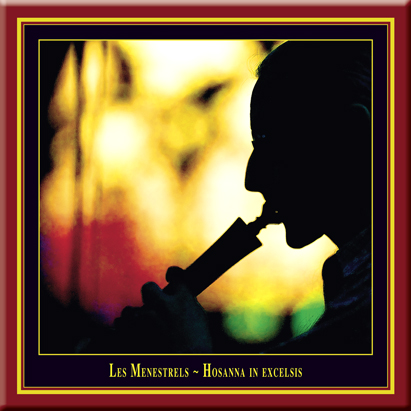
Les Menestrels works by 1 CD, DDD, 73 minutes, |
|
Play and pleasure are necessary to the sustenance of human life. However, all services useful to human sustenance must be regarded as permissible. Therefore, the services of menestrels, which are intended to provide cheer, are not a forbidden thing, provided that they are not in a state of sin, and they exercise moderation in their playing - namely that they use no hateful words and do not begin playing during work or at forbidden times. And those who support the menestrels are not committing sin! Rather, they deal justly when they give them for their services that which is their due. "As stated above..." |
|
Texts and music from the spiritual world of the European Middle Ages form the subject matter of this programme, which the Les Menestrels Ensemble has put together specially for this performance held in the monastery church at Maulbronn. One is astonished by the abundant variety of language and subject matter on offer here. Yet perhaps even more astonishing is the widespread, cross-border dissemination of a body of religious and cultural thought that flourished outside church walls. In today’s monotonous popular culture, shaped as it is by the dogma that what sells is what matters, cultural and human values no longer enjoy pride of place. Linguistic standardisation is pursued aggressively, and dialects, expressions and cultural resonances travel beyond regional borders in only the rarest of cases. In the song as cultivated in the Middle Ages, however, we find a linguistically multifaceted culture; one that is, in this sense, truly more European. Modern media have wrought little improvement. On the contrary, inquisitorial surveillance has found its match in the uniformity-enforcing filter of a profit-oriented business management "culture." The Church may well have imposed strict guidelines, as Klaus Walter describes in the notes below, but at least the themes that were the focus of artistic creation were those by which human beings are moved, and wit and subtlety challenged the human intellect. Josef-Stefan Kindler |
|
Numbers offered a means by which to establish order and, in the process, reclaim for oneself a bit of paradise. It is therefore no accident that many scholasticists engaged in study of the Kabala, the doctrine of the significance of number combinations. By imposing order on one’s conduct—or on a composition—one was able to create in miniature an image of heaven. The particular order imposed did not have to be readily discernible. A de facto order sufficed.
It may be that Kabalistic number symbolism occasionally played a role in the isorhythmic motet, similar to the role it was recently demonstrated to have played in the compositions of J.S. Bach. This method of composition declined in importance towards the end of the 14th century; however, the motet principle, whereby a strictly defined role is assigned to each voice, continued to find expression in the cantus firmus technique, in which form it long retained its influence.
Klaus Walter |
|
Concerts and radio and television recording sessions have taken the ensemble to nearly every European country and to the USA, Canada and Japan. The ensemble has made recordings on the Westminster, Amadeo, Belvedere and Mirror Music labels. Les Menestrels have performed at festivals including the Vienna International Festival (Wiener Festwochen), the Salzburg Festival, the Festivales d‘España, the Festival Estival de Paris, the International Organ Week in Nuremberg, the Passau European Festival (Europäische Wochen Passau), the Lucerne International Music Festival, the Dubrovnik Festival, the Schwetzinger Festival, Music in Old Krakow, Festivals in Osijek, Flanders, Istanbul, Ljubljana, and Ochrid, the Maulbronn "Monastery Concerts," and many others. Birgit Kurtz ~ soprano, Florian Mayr ~ countertenor, Kurt Kempf ~ tenor, Erich Klug ~ bass The complete libretti and texts of the performance: ~ as website ~ |
|
The history, the composers and the works
Gherardello de Florenzia (1310–1370) Guillaume de Machault (c. 1300–1377) Hermann, Monk of Salzburg (second half of the 14th century) Heinrich von Mügeln (14th century) Guillaume Dufay (1400–1474) Alfonso el Sabio (1221–1284, reigned from 1252) Johannes Bassart (mid-15th century) Kolmarer Liederhandschrift (15th century) Oswald von Wolkenstein (circa 1377 in Schöneck/Alto Adige–1445 in Neustift/Brixen) The Mensural Codex of Nicolaus Apel Cancionero Musical del Palacio and Cancionero Musical de la casa de Medinaceli Montpellier Codex Squarcialupi Codex (Florence, Medicea Laurenziana pal. 87) |
|
1. Concert start 2. Psalm 115: "Nicht uns, o Herr, nicht uns..." 3. Benedicamus Domino 4. Groß bist du, Herr... 5. Benedicamus Domino 6. Ich liebe dich, Herr... 7. Benedicamus Domino 8. Wenn ich scheine mußt Du leuchten... 9. Aucun - Amor - Kyrie 10. "A" setzen wir, das ist unser Herr und Gott... 11. Tribulatio proxima est 12. Oh Himmel-König... 13. Christe - Veni creator - Tribulatio 14. O Mensch, bezeichnet und geziert mit Gottes Ebenbild... 15. Nova laude, terra, plaude... 16. Omnis mundus - Omnes nunc 17. Wie uns die Heiligen helfen 18. Arcangel San Miguel... 19. Der heilige Erzengel Michael 20. St. Martein, lieber Herre... 21. Quem terra, pontus, aethera... 22. Durch die Frau kam das Übel - durch die Frau kam das Gute... 23. Ad laudes marie cantemus hodie... 24. Einen gekrönten reien... 25. Sancho Pansa: "Und hätte ich auch nichts anderes..." 26. Praeludio: "Santa Maria amar..." 27. Gran dereit... 28. Nachdem der Heide alle Darlegungen angehört hatte... 29. O flos flagrans... 30. Vergine bella... 31. Ave mater o maria... 32. Predigt: "Der Tanz ist ein Ring oder Zirkel, des Mittel der Teufel ist..." 33. Chaldivaldi "Wie schon oben gesagt..." |


 While liturgical music, with its ties to the mass cycle, embodies a more or less uniform spiritual outlook from one stylistic epoch to another, non-liturgical sacred music presents a varied palette of expressive forms shaped by the most varied manifestations of religious thought. We have selected some of the most significant themes and complemented them with texts devoted to similar or related subject matter. Most of these themes speak for themselves. Worship of God, pleas for the forgiveness of sins and for divine benediction, cries for succour in various afflictions, devotion to the Virgin Mary and appeals for intercession: these require no explanation. One group of musical works, whose origins in a specific philosophical approach to religion—scholasticism—are not immediately apparent, may require some explanation.
 The intellectual movement known as scholasticism does not present a uniform picture; common to all scholasticists, however, was the conviction that the mysteries of faith could be described or established by intellectual means. They were fascinated not only by logic, but also by arithmetic and geometry. Nikolaus Cusanus, for example, based his description of God on the concept of an unending straight line, and religious speculations brought Ramon Lull to the verge of discovering integral calculus (the "squaring of the circle"). From time immemorial, the principle of "order" has stood for the divine, for heaven; "disorder" is associated with the earthly realm, if not indeed with the infernal. A visual representation of plants with symmetrically arranged blossoms is a depiction of paradise. We know that we are earth-bound when plants grow irregularly. The movements of dancing angels always trace circles or other geometrical figures. Dancing devils move in a chaotic mass. Sinners may even dance upside down (depictions of Salome).
 In the course of the fourteenth century, such thinking began to be reflected in music as well. It was most readily applicable to the motet, a form that had emerged already in the thirteenth century. The motet owed its very existence to an intellectual principle: An excerpt of Gregorian chant provided the tenor, which functioned as the composition’s foundation. It was identified with the sacred ("auf Gott sollst du bauen" [Thou shalt build upon God]), as it had been in the earlier organum of the Notre Dame school. The texts underlying the upper voices were sung simultaneously, yet differed from one another, sometimes even with respect to the languages they were written in. They were required, however, to hold references to one another and to the text of the tenor, even though the latter was usually suggested by a single word, if indeed the tenor was not simply delegated to an instrument, as was often the case. The upper voices (motetus and duplum) belonged to the worldly domain. In the motet "Aucun – Amor – Kyrie," the motetus conveys in Latin the view that carnal love incurs harm in all circumstances—certainly in this world, to say nothing of eternity. The duplum, however, asserts in the profane language (French) that love is a source of bliss for those who fulfil certain conditions. It is conceded, all the same, that but few human beings are capable of fulfilling these conditions, both voices joining in the tenor’s "Herr, erbarme dich unser" [Lord, have mercy upon us]. With the mystical poem by Mechthild von Magdeburg we have added to these two aspects of love a third.
 The double hocket by Guillaume de Machaut is not, strictly speaking, a motet at all, as its upper two voices are textless. All the same, it is best thought of as belonging to this genre or, to be more precise, to that of the isorhythmic motet. The term ‘isorhythmic’ refers to a structural principle whereby rhythmic and melodic patterns are organised on the basis of numerical relationships. In the 14th century, it found its ideal application in the motet. The honour of being organised in this manner naturally fell to the tenor. The upper voices were seldom structured isorhythmically and, if they were, only in part (as in the mass by Guillaume de Machaut).
 In this double hocket, the tenor melody is heard three times in the first section. The entire section is made up of eight rhythmically identical segments (each isorhythmic segment thus comprising three eighths of the tenor melody). In the second section, the tenor is assembled from the first four notes of every third isorhythmic segment in the first section, the tenor melody thereby assuming its original shape. The upper two voices are, even without texts, recognisably profane. Their movements, which appear to be without form or pattern, suggest two cogs with irregularly spaced teeth (the title itself refers to this type of motion: hocket < Fr. hoquet = ‘hiccup’). As though miraculously, these teeth nonetheless succeed in engaging one another, thanks to the iron grip of the inscrutable but well-ordered tenor, a simulacrum of the bond between God and the world.
 Much more space is devoted to the theme of the Virgin Mary as reflected in the musical and literary legacies, where it became virtually a subspecies of the minnesang. It is no accident that the minnesang and the cult of the Virgin Mary both reached their zenith at approximately the same time. Virgin Mary veneration also afforded poets and poet-composers certain advantages, some acknowledged, some no doubt unacknowledged. It allowed one, for example, to compose poems to a beloved lady under the guise of a Marian song. This is believed to have been the background to Petrarch’s "Vergine bella," for example. But the Virgin Mary theme also made it possible to introduce human, and therefore generally understandable, references to the otherwise often very abstract architecture of the religious edifice. The most varied of basic human impulses are addressed, such as the veneration of motherhood, or the pleasure in awe as expressed in tales of miracles performed by the Virgin Mary (Cantigas de Santa Maria). Alfonso el Sabio commanded his entire royal household of scholars, poets and musicians to gather every available report of such miracles, to put them into words and music, and to write them down. That a number of ethnocentric and anti-Semitic ideas also found their way into the results of these efforts did not seem to trouble him, for all that he had brought together at the university he founded in Cordoba—Christian, Jewish, and Arab scholars alike. But Mary is also celebrated in countless songs as a key to the patriarchy’s backdoor. The mother whose son cannot refuse her request, according to established custom, if she shows him her breast, and whose son for his part regains the power to appease the wrath of God the Father ("ladder of salvation"), is invoked as an intercessory. Most importantly, however, we should not overlook the fact that many of the Marian texts and songs count among the most beautiful of all the lyrical productions of the Middle Ages.
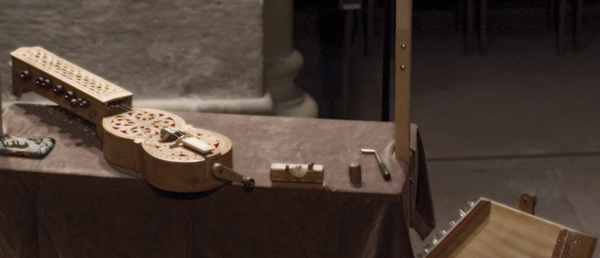
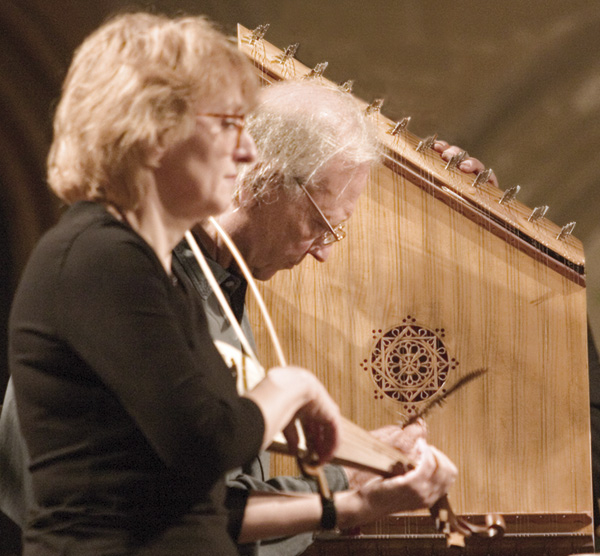
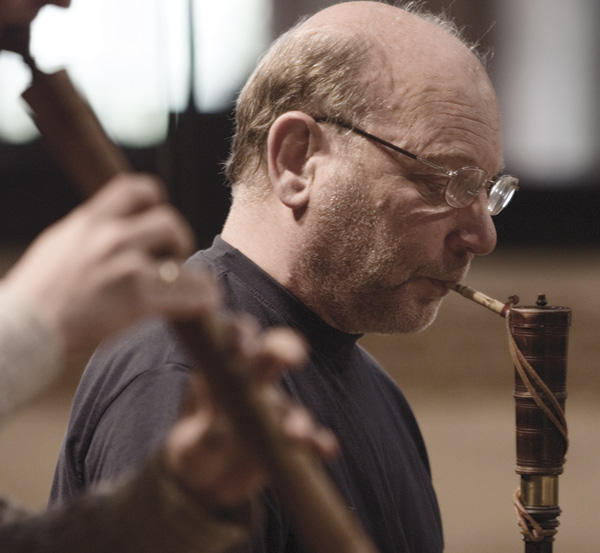
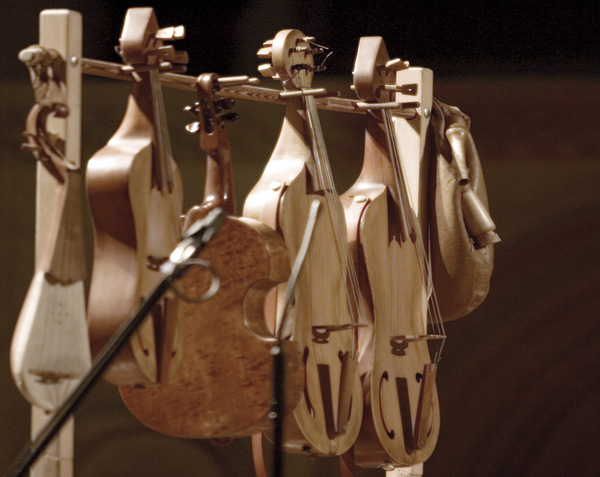
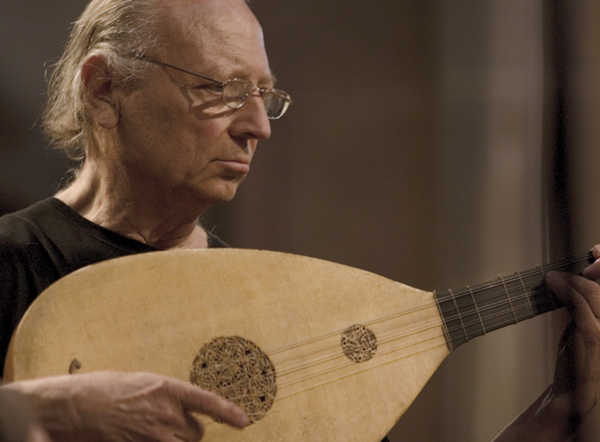
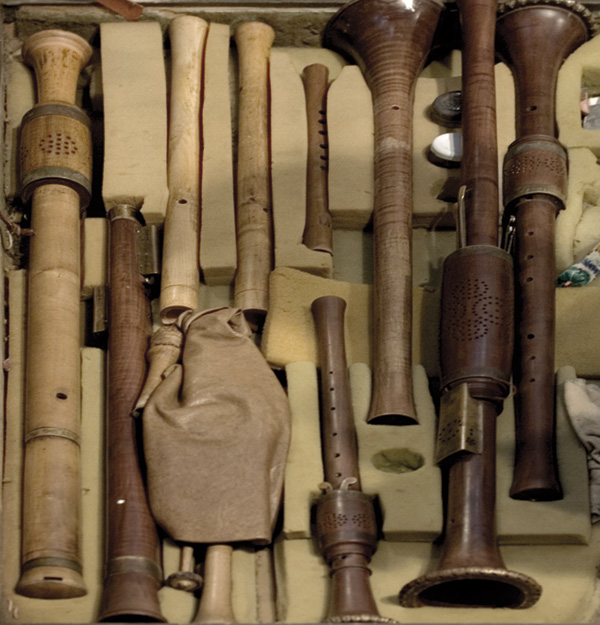
 The Les Menestrels Ensemble was founded in 1963 by Klaus and Michel Walter. Their original involvement with the music of the 20th century eventually led to an interest in the structural polyphony of 14th and 15th-century music, as exemplified by the Ars Nova in particular. The works of this period continue to be the group’s main focus, although their repertoire has expanded to include works written up to about 1600. Their historical instrumentarium has gradually grown to enable as faithful a reproduction as possible of each period’s characteristic sound. Les Menestrels achieved their first major success at the 1965 Wiener Festwochen (Vienna International Festival) with their staged performance of the cantefable "Aucassin und Niclolete," for which H.C. Artmann contributed the translation. To programmes consisting entirely of concert music they subsequently added programmes with a literary thread, or those that included staged performances. The group has not entirely forgotten its origins in the contemporary music field, however. One of their programmes features a comparison of parallel aspects of old and new music. Depending on the programme, four to ten singers and instrumentalists participate in the ensemble’s concerts. They have access to some 70 historical instruments authentic to the period between 1200 and 1600.