|
The Ensemble
Michael Mücke - Violin · Jens Peter Maintz - Cello · Wolf Harden - Piano
Artists & Works
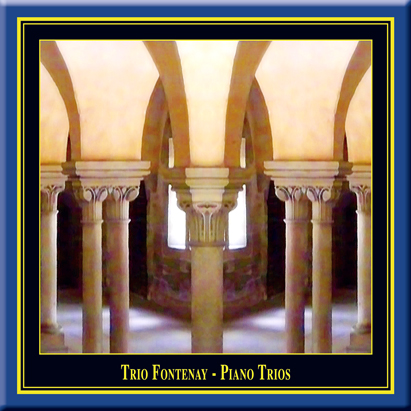
The sweeping impulsivity and musical gauge of their interpretations have led these "three divine sons" (Süddeutsche Zeitung) to where they are today. Undoubtedly, Trio Fontenay is currently the most renowned German piano trio. A fast-paced career developed in the mid-1980s, during the course of which the "young, wild ones" were continual guests at Europe's larger festivals. In 1986 they had their American debut. Since then, one or two large annual tours take them through the USA and Canada, within the scope of which the trio regularly performs in major metropolitan cities such as New York, Los Angeles, Chicago, Montreal and Toronto. The ensemble's comprehensive repertoire is a cross-section of all piano trio literature, and with its interpretations impressed with intensity and faithfulness, Trio Fontenay has always aroused great acclamation from both its public and critics alike. For their complete recording of the Beethoven Trios, Trio Fontenay was award the annual prize by Deutsche Schallplattenkritik, as well as the French "Diapason d'Or". In Paris, the trio was appointed Châtelet Theatre's resident trio.
In this recording they play Piano Trio No. 1, op 35 by the Spanish pianist and composer Joaquin Turina from the year 1926 - a piece previously unrecorded by the Trio. Together with Manuel de Falla, Turina is held as the most outstanding representative of the modern Spanish school, which was motivated by French Impressionism, but in its melody, however, is attached to the folk music of Andalusia.
The second part of the concert includes Piano Trio in E-flat Major, op. 70 No. 2 by Ludwig van Beethoven. Carl Czerny, composer and student of Beethoven, says of this work, "this trio is no less great or original than its successor (Trio D-major, op 70 No. 1), but it is of a very different, less serious character." The trio in e-flat major was composed during the summer of 1808 immediately after the Sixth Symphony, and applies foreseen traits to Romanticism. Beethoven expands his realm of expression here in two somewhat converse directions: both in a seemingly romantically tonal colourfulness, and towards the inclusion of classic style elements by means of a stricter introduction.
Michael Mücke plays a violin from Gaspare Lorenzini (Piacenza 1780); Jens Peter Maintz plays a Violoncello from Vincenzo Rugeri (1696).
|